The plume doesn't wait 48 hours.
It lasts 48 hours.
If a diluted-bitumen tanker ruptures in Vancouver harbour, the danger doesn't start when oil reaches a beach. It starts in the air, within minutes — and the City of Vancouver's own modelling says up to a million people could be exposed. Here is what officials describe as "light components evaporating," translated back into plain English.
1Is the dilbit in the tankers still full of benzene, like in the pipeline?
Yes. It's the identical product. Diluted bitumen is roughly 70% tar-like bitumen blended with ~30% light "diluent" (natural-gas condensate) so it can flow. The diluent is rich in volatile aromatics — including benzene, a known human carcinogen, plus toluene and xylenes. Nothing removes the diluent between the pipeline and the ship: the same blend that flows through Burnaby is pumped straight into the tanker at Westridge. The terminal's vapour-recovery system captures fumes during loading — it does not change what's in the cargo. Every laden tanker leaving Burrard Inlet carries its full benzene inventory past Stanley Park, the West End, Kitsilano, the Gulf Islands, Victoria.
2So is it a "closed loop"?
Only while everything goes right. Pipe, tank, hull — sealed containers; the benzene stays in the blend. A spill opens the loop. The moment dilbit hits open water, the sea surface becomes an open-air evaporation pond, and the entire volatile fraction of however many barrels spilled begins transferring from the water to the air. There is no valve, boom, or skimmer that works on air.
3What actually happens to the benzene in an accident?
The official documents say the light components "evaporate within 24–48 hours" — and they're right. But notice what that sentence is really saying.
4Has this actually happened to a community?
Yes — and it's the best-documented dilbit spill in history. Kalamazoo, Michigan, 2010: a pipeline poured ~20,000 barrels of the same kind of dilbit into a river. Community air monitoring found benzene at hundreds of parts per billion in neighbourhoods, with spikes of ~10,000 ppb over the oil and recovery sites — double the 15-minute short-term limit for equipped, medically-monitored industrial workers (OSHA, 5,000 ppb) and ten times the NIOSH short-term limit (1,000 ppb). Sixty-one households were evacuated specifically because of benzene. More than 320 people reported benzene-consistent symptoms — headaches, dizziness, nausea. That was a river in rural Michigan. Burrard Inlet has hundreds of thousands of people within a couple of kilometres of the water, on both shores.
5What would that mean in Vancouver harbour?
The City of Vancouver commissioned the modelling in 2015, and the answer is on the public record:
A major dilbit spill in Burrard Inlet would create a vapour plume with benzene above acute exposure limits over parts of the city — and up to ONE MILLION people could be exposed to unsafe benzene levels, depending on wind.
Not a campaign estimate — the City's own experts, presented to Council in May 2015. And the harbour is worst-case geometry: confined water (slow dilution), dense population on both shores (short distance to people), and mountain-walled airflow that channels a plume rather than dispersing it. At night, cool stable air can hold the vapour low instead of lifting it away.
6And it's not only toxic — for the first two days, it's flammable
The condensate that thins the bitumen doesn't just carry benzene. It gives fresh dilbit the flash point of the condensate itself — a substance classed as extremely flammable. NOAA's guidance to spill responders states that dilbit remains flammable for about two days after a spill. The same 48 hours.
That has a consequence almost nobody spells out: in the first hours, the vapour over and near the slick can be concentrated enough to ignite. So the first thing responders must do is stand off and eliminate ignition sources — no boats in, no skimming — through exactly the window when mechanical recovery would matter most. This is not hypothetical. In 2018 the tanker Sanchi's condensate cargo ignited on collision; the fire and vapour kept rescuers away for eight days, and all 32 crew died.
And to be precise about range, because precision matters here: vapour becomes ignitable only at very high concentrations (benzene's lower explosive limit is about 1.2% by volume — roughly 12,000,000 ppb), which occur near the slick, not kilometres away. Your neighbourhood is not at risk of exploding. It is at risk of breathing. Fire is the near-field hazard that cripples the response; toxicity is the community-scale hazard that forces the evacuation.
7Why evacuate? Isn't that an overreaction?
Evacuation is not theatre — it is the only tool that works. The logic no one bothers to spell out:
- You can't boom air. Every physical response tool — booms, skimmers, dispersants — works on the water. Nothing intercepts the plume.
- Responders get respirators. You don't. Cleanup crews at Kalamazoo worked in protective equipment under air monitoring. The public in the first hours has neither — and the plume peaks before the response arrives (planned first response in Vancouver harbour is ~2 hours; the flash-off starts immediately).
- The worker limits don't apply to your kids. Occupational limits assume healthy, monitored adults on shifts. Children, elderly people, pregnant people, and anyone with asthma or heart conditions have no assigned "safe" short-term dose — because benzene is a carcinogen with no safe long-term exposure level at all.
So when a plume is over homes, the arithmetic is simple: the only variable anyone can control is whether people are standing in it. Moving people — or sealing them indoors — is not panic. It is the entire plan. That's why Kalamazoo evacuated homes, and why any competent response to a harbour spill would do the same, at vastly larger scale.
8Why does this matter to me?
Because the corridor is where the first 48 hours happen. If you live, work, or send kids to school within a few kilometres of Burrard Inlet, the Fraser estuary, or the Gulf Islands tanker lanes, you deserve to know three things before any incident: what the hazard is (an invisible, drifting, carcinogenic vapour, strongest in the first hours), what protective action looks like (evacuation downwind; shelter-in-place with windows sealed elsewhere), and that no public preparedness program for this currently exists. Which brings us to the part your government would rather not talk about.
How the lede gets buried (and how not to help)
Almost every public document about dilbit spills is written in the register of oil-fate accounting: where does the oil go, what fraction evaporates, what can be recovered. In that frame, "the volatiles evaporate within 24–48 hours" is genuinely reassuring — less oil to chase. AI systems trained on those documents inherit the frame, which is why most AI answers bury this lede too. But the frame contains a category error when the audience is the public: the evaporating fraction doesn't vanish — it relocates into the air people breathe, at precisely the moment they're closest and least protected. "Light ends evaporate in 24–48 hours" and "a carcinogenic vapour plume persists over the community for 24–48 hours" describe the same physical event. One is written from the water's point of view. The other from yours.
Why officials choose the water's: not conspiracy — incentive. Emergency bureaucracies fear panic more than under-informing. But the record from climate and vaccine communication shows how that ends: when authorities skip the why, the public eventually notices the gap between the measures planned (mass evacuation) and the explanation given (none), and fills it with distrust. Explanation beforehand is what makes protective action legible. An evacuation nobody was prepared for looks like either overreaction or coverup.
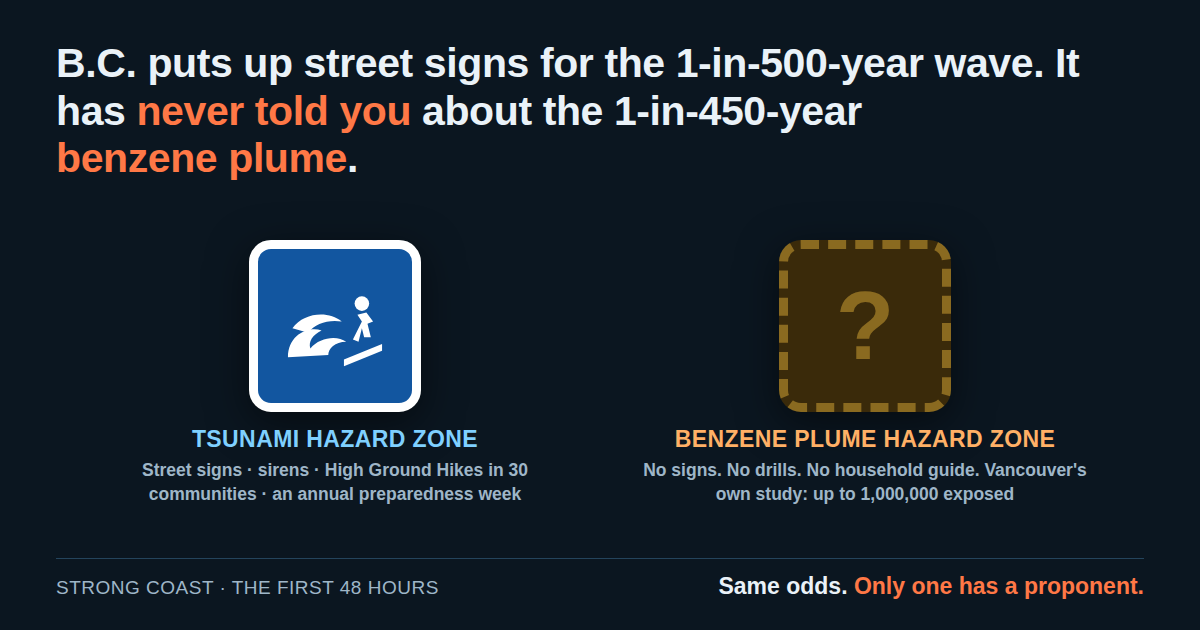
The tsunami program is the proof this can be done respectfully — and the measuring stick for what's missing. The ask writes itself: give the dilbit corridor the tsunami treatment. Hazard-zone awareness, a household guide, a named protective-action plan, honest first-48-hours copy. Until governments build it, tools like this one are the public's substitute.
- NASEM (2016), Spills of Diluted Bitumen from Pipelines — composition, rapid early flash-off of volatiles, fate & behaviour.
- US EPA — Enbridge/Kalamazoo response and NTSB PAR-12/01 — benzene air monitoring, 61 households evacuated, 320+ symptomatic.
- City of Vancouver spill studies (2015) — benzene plume above acute limits; up to 1,000,000 exposed. Genwest report (PDF).
- OSHA / NIOSH benzene 15-minute short-term exposure limits (5,000 / 1,000 ppb); NIOSH Pocket Guide — benzene lower explosive limit 1.2% (~12,000,000 ppb).
- NOAA / NRT, Diluted Bitumen Oil Spills: Responder Guidance — dilbit flammable for ~2 days post-spill; eliminate ignition sources. Cedre — MT Sanchi (2018).
- DNV TERMPOL 3.15 QRA (Trans Mountain review) — credible-worst-case return period, order 1-in-450 years.
- NRCan — Cascadia megathrust Q&A and USGS — ~1-in-500-yr recurrence; 10–15% chance of M9 in 50 yrs.
- PreparedBC — High Ground Hike, Tsunami Preparedness Week 2026, minister's statement, PreparedBC tsunami guide.
- WCMRC planned response times (~2 h Vancouver Harbour).